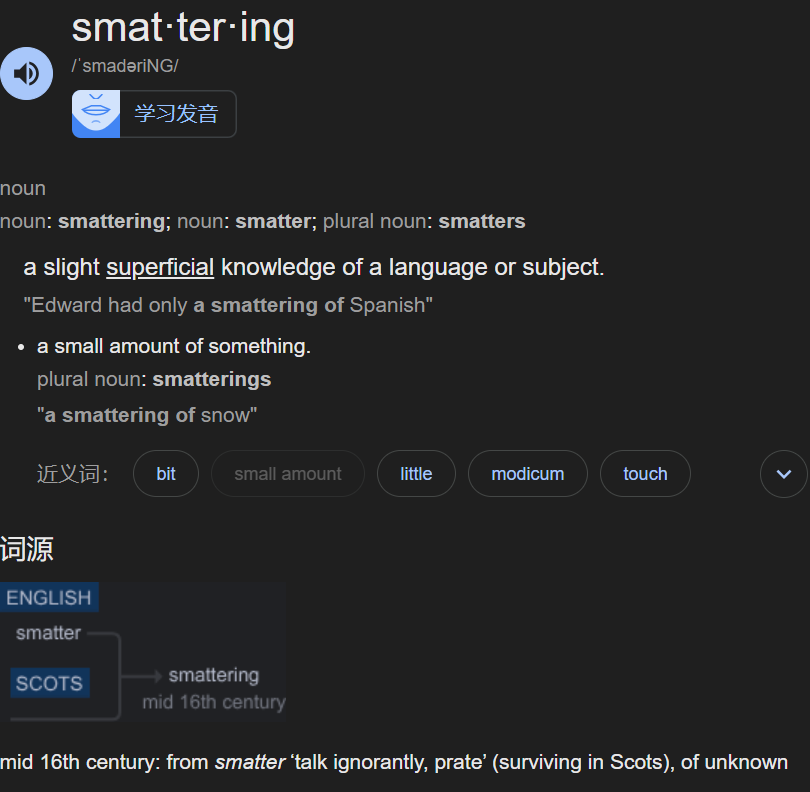
Conventionally, investors want the assets they hold to make them money—and not just owing to rising valuations. Bonds spit out coupons; stocks offer dividends. Gold is different. It emanates no cashflows. Its smattering of real-world uses, in jewellery-making or electronics, hardly justifies its hefty presence in many portfolios.
Its smattering(small amount of) of real-world uses, in jewellery-making or electronics, hardly justifies its hefty(of comparatively great physical weight or density) presence in many portfolios(=finance, a collection of assets held by an institution or a private individual).
拆解解释:
Millennia(注意不要和millenial混了) = 数千年、几千年(millennium 的复数形式,1 millennium = 1000 年)
Fascination = 强烈的着迷、迷恋、 fascination(比 interest 强烈得多)
The stuff = 这里指 gold(黄金),属于口语化、轻松的表达,避免重复前面提到的 gold
Mean its value will never fall to nothing = 意味着它的价值永远不会归零
come into one's own(大展身手)
roil=disturb
Some hedge.:这是全文最精彩的反讽 → “Some + 名词” 在英语中常用来表示讽刺。 “Some hedge.” = “这算哪门子避险资产啊!” / “避险个鬼!” (字面意思是“真是个避险资产呢”,实际是强烈的否定和嘲讽)
Part of what is going on is that gold tends to suffer when the yields on inflation-protected bonds (or real yields) rise. A lump of metal issues no interest payments but, like an inflation-linked bond, its principal(本金) is protected against rising prices. But when those bonds’ inflation-indexed payouts rise, gold—which continues not to pay any interest—becomes relatively less appealing.
Inflation = 通货膨胀
Indexed = 挂钩的、指数化的(index = 指数)
Inflation-indexed = 与通胀挂钩的 / 随通胀调整的
Real yields have leapt(leap) since America and Israel began bombing Iran. Those on ten-year American Treasuries have gone up by 0.3 percentage points. This reflects a riskier global environment and angst(concern) that higher oil prices will stoke(add fuel to) inflation, forcing central banks to raise their benchmark interest rates.
英文词,语气强度,含义侧重,例子
Angst,较强,深深的不安 + 焦虑,文章中这种用法
Anxiety,强,焦虑(最接近 angst),心理学术语感更强
Dread,很强,恐惧、 dread(害怕发生),更偏向害怕
Apprehension,中等,担心、忧虑,比较正式
Unease,中等,不安,更轻一些
Concern,较弱,关心、担忧,最中性
Panic,极强,惊慌失措,太夸张,不合适
Another explanation is central banks’ management of the yellow metal. In countries spooked by the prospect of Western sanctions—like Russia, whose foreign-currency reserves were frozen after it invaded Ukraine—gold can serve as a handy hedge against weaponisation of the dollar. Elsewhere it offers a way to diversify their reserves. But when its value jumps, as it has in the past few years, cashing out some of the profits from the rally starts looking attractive to central bankers eager to buttress(support /ˈbətrəs/) their country’s currency or governments keen to generate cash for other purposes.
In the fortnight to March 20th Turkey sold $8bn-worth of gold to prop up(support, bolster, sustain, shore up) the lira. India may be doing something similar. The governor of Poland’s central bank recently mused(pondered, contemplated, reflected, thought about) about locking in some of the profits from the run-up(surge, rally, upswing, rise) to help bankroll(fund, finance, sponsor, underwrite) defence spending. Other such opportunistic divestments(the opposite of investment) would explain some of the latest drop.
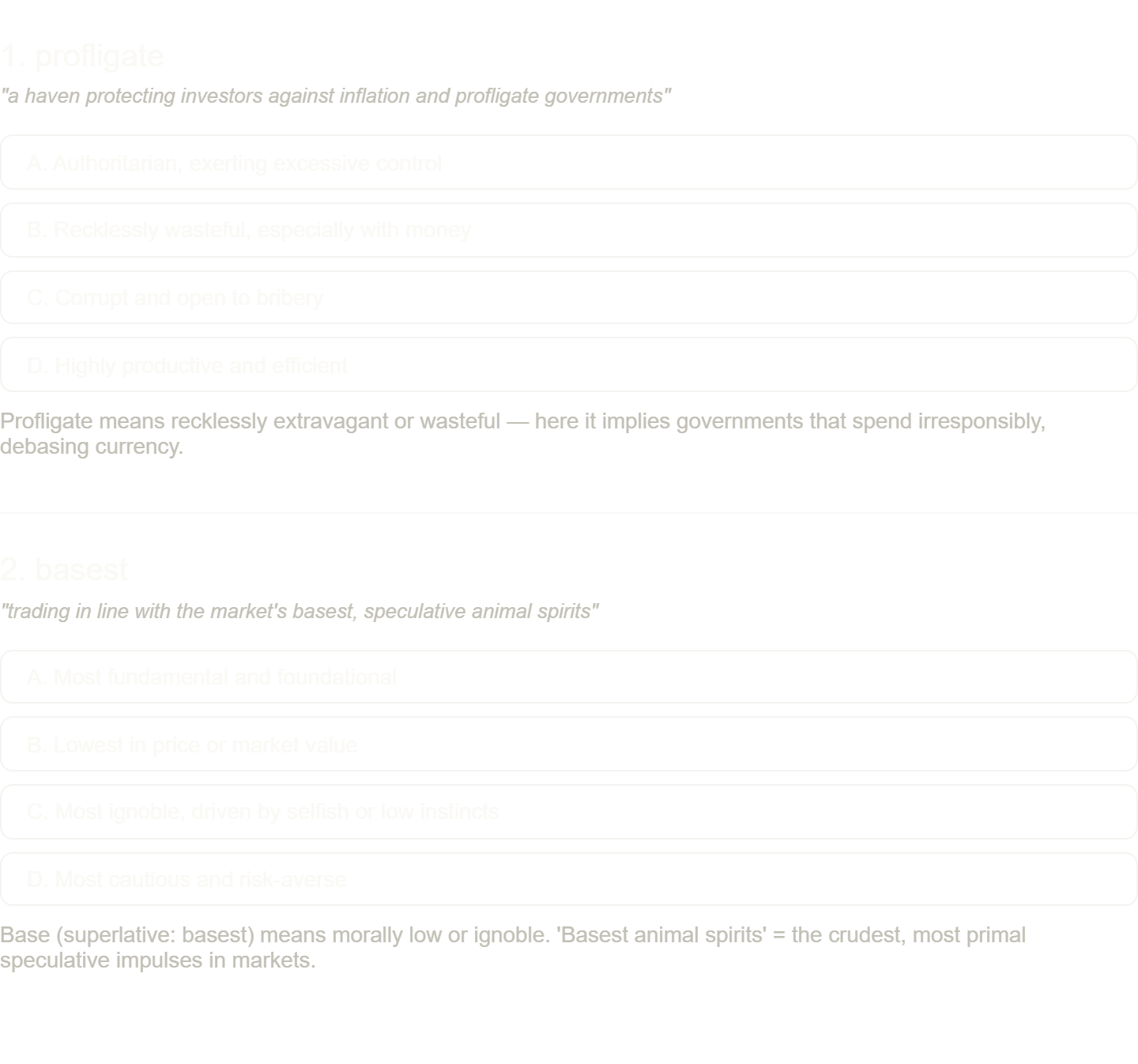
Yet neither rising real yields nor central banks’ sales fully explain gold’s recent behaviour. Another explanation of what is going on with gold is to think of it as becoming like the asset that was meant to replace it. Bitcoin was once heralded as “digital gold”—a haven protecting investors against inflation and profligate(recklessly extravagant or wasteful — here it implies governments that spend irresponsibly, debasing currency) governments, and insulated from the long arm of Uncle Sam. Instead it developed the unfortunate habit of trading in line with the market’s basest(morally low or ignoble. 'Basest animal spirits' = the crudest, most primal speculative impulses in markets), speculative animal spirits.
The past few weeks show, in other words, that gold is not a universal hedge. Still, gold’s chief historic appeal is not as protection against Gulf wars, or even an energy shock, but against the debasement of money. This is a giant risk amid mounting(increasing) public debts, which governments may seek to inflate away. You would expect gold to rise when America wages(=start) another expensive war and other indebted countries consider subsidising citizens’ energy bills—but only if other things are equal. When the momentum-chasers outnumber the debasement traders, and when institutional investors sell at a profit to cover losses on other assets, other things aren’t equal.
In time, the momentum-chasers will inevitably find another asset to take them “to the moon”. The debasement trade will then reassert itself and gold may regain a semblance of its safe-haven status. Knowing what price will purge the last of the fair-weather gold bugs is another matter altogether. ■